Showing posts with label travel. Show all posts

Thursday, April 26, 2007

The worthwhile Algarve

Portugal is not España, but we share the peninsula with her. And it was about the only place on the peninsula that didn't receive rain during this year's Semana Santa. The Easter holidays were a real washout for those who had gone to Spanish coast to lie on the beach or to Sevilla to watch the processions.

Alex and I spent the long weekend meandering through the (rainless!) Algarve, the southern coast of Portugal (map), in search of the less-beaten path through the region. We fell in love with some places and others made us cringe and get in the car and keep driving. The area is popular with good reason, but, as we found, there's a lot more to see beyond the big overdeveloped and tourist-ridden cities like Faro, Albufeira, and Lagos.

So, if you, like us, prefer to experience a more authentic Algarve and find secluded beaches and so forth, I have two main recommendations.

1. Just east of Faro you'll find the largest fishing port in the Algarve. It's called Olhão and it's not a prettified place. It's real and gritty, and full of Portuguese who make their living fishing in the Atlantic Ocean. There are two pensão in town, and the very helpful owner of ours gave us the ferry schedule to the islands just off the coast of Olhão. The ferry cost about 3 euros round trip, and was filled with Portuguese heading home to the island with their dogs and shopping bags.
We spent an idyllic afternoon on the Ilha da Culatra, where the fishing community is alive and well, sidewalks are the only streets, and the beaches are pristine. Having not eaten lunch, we headed for the first restaurant we saw after getting off the ferry. The waitress there didn't speak English or German, and there was no menu. She asked, in Portuguese, if we wanted fish or meat (how could we even think of eating meat on this island?)--I chose tuna and Alex swordfish. She brought out an appetizer of some of the most delicious steamed clams I'd ever eaten (above). The fish was grilled with green peppers and onion and very tasty. She also brought out a fresh green salad and crusty bread. We washed it all down with cerveja Sagres, which is remarkably good. She charged us 20 euros for everything.
We then wandered out to the beach, which we had to ourselves. After sitting in the sun for a while, we set off down the beach for Farol, another cluster of houses at the other end of the island, where we'd be getting the ferry back to Olhão. Farol, home to a lighthouse, was just as charming, but clearly more of a weekend house-type place, without the fishing business of Culatra.In Farol, the ferry unloaded what seemed like hordes of people, equipped with food and supplies for Easter weekend on the island, and we boarded the noticeably lighter ferry to ride back to Olhão, the setting sun and a trail of seagulls behind us.
2. Go west! After Olhão, the farther west you can get, the better. The highway ends, the hillsides covered with high rises cease, and there is generally more vegetation and fewer people as you head towards Sagres, the closest town to Cabo de São Vicente, or the southwestern most point in Europe. The coastline between the two places, about six kilometers long, is composed of stunningly high cliffs and the waves that batter them. The landscape is fantastic. A highly recommended beach is Praia da Beliche, about halfway between Sagres and the Cape, full of surfers and people enjoying its beautiful, wind-protected cove (below).We stayed in Salema, on a recommendation from a friend who had been and described it as "two streets with one hippie bar." When the highway ends soon after Lagos, you must take a national road to get any further. Salema is off this two-lane road: you drive several curvy kilometers towards the coast until the road ends and you're in Salema, which sits right on the beach. It's a tiny little town that's getting bigger thanks to construction of apartments up the hillside opposite the town proper. But it's not spoiled (yet) and there are so many fewer people than at other spots, that even if everyone is English or German, it just doesn't matter because the beach is so lovely and it's so peaceful.

Alex and I went to the Algarve with no reservations anywhere. We found a place to stay by wandering Salema's only street until a sign offering an apartment for rental caught my eye. We ended up renting a room in a two-bedroom apartment with a terrace, a well-equipped kitchen, and spacious living room for only 35 euros a night. (The man rents the place in August for significantly more.)We spent our last day in the Algarve in our own little cove in Salema, shielded by rocks on either side, until the tide got high enough that we knew it was time to leave.

Wednesday, April 18, 2007

Almanzor

I spent last weekend in a beautiful snowy place just two hours from Madrid: the Sierra de Gredos. A friend invited me on an expedition to Almanzor, the highest peak in the Sistema Central, or the chain of mountains that crosses the Iberian peninsula from Lisboa to Valencia. Almanzor is 2592 meters tall, or 8501 feet, and my friend had been wanting to climb it for some time.

I knew nothing about the peak before he mentioned the trip, and I read a bit about it in the links he included in his emails. But for whatever reason, I didn't fully digest the information. When, on our first day out, we arrived at Los Barrerones, a flat spot high above the Circo de Gredos (the Gredos Cirque), and my companions pointed out Almanzor -- an amazingly beautiful peak, a rocky horn rising from the cirque -- I thought, "How the hell are we going to get up that?"

It looked, for all means and purposes, like the Matterhorn. You know, one of those breathtakingly high peaks that you can't even fathom how people climb. Much less you.

None of this is to say I am inexperienced in the mountains. I have spent plenty of time in the hills but, above all, climbing the 4,000 footers of the Adirondacks and completing long circuit hikes, like the Alps Haute Route and a circuit of the Torres del Paine in Chile. Ascending peaks in the winter is very different, especially when you have to use an ice ax and crampons and the vertical drops are enough to make your stomach flip.

We got a bit of a late start on Saturday morning from the Plataforma de Gredos, the parking lot that gives good access to the area. The original idea had been to walk to the refugio (about two and a half hours), drop off our heavier material (sleeping bags, extra clothes, etc.) and then continue up to the summit of Almanzor (another couple hours) before descending to a hot meal and bed at the refugio.

We arrived at the refugio sometime around three o'clock. After eating something and getting our gear ready to ascend, it was nearly four. Dinner would be served at eight. On the advice of several people sitting outside the refugio we decided to postpone our summit attempt to Sunday morning. We'd start early, the snow would still be hard, and we'd be well-rested. So we spent Saturday afternoon heading up the trail to Almanzor to practice with our crampons and ice axes.

But on Sunday the group was ready to give up: one member had awoken with a sore throat and another's boots were completely soaked through. I couldn't help thinking that it would be a real shame to not even give it a try. So I said that. The sore throater said he had no problem waiting several hours for us, so the remaining three departed uphill, over the snow-covered rocks, under a cerulean blue sky.

The landscape of this area is just fantastic. The refugio is situated at the southeastern end of the Laguna Grande, a beautiful lake (above) surrounded by the peaks of the cirque. It had been snowing the week before, so everything was covered in snow. But since the sun was shining all weekend, the snow got soft during the day and hundreds of little streams began running. One of the benefits of going in the winter is that there's tons of water--and the sounds of it--everywhere. There are several waterfalls en route to the summit. In summer, apparently, it's a bit of a rocky wasteland with not a drop of water in sight (except for what's in the lake) and quite hot.

Shortly we were far beyond where we'd reached the previous afternoon, moving slowly and making sure that with each step the crampons and ice ax were in place. The trail just keep getting steeper and if I looked back, I started to fear the way down. One of my companions had commented on Saturday that she thought we had gotten quite far in our practice session. This was an illusion--it's not much distance to the summit (a kilometer or two) but, from the refugio, you have to climb nearly 600 meters up in that distance.

Pretty soon we could see the Portilla del Crampón, the tiny pass one has to cross to reach the last pull to the summit. But there were still a hundred meters or more to that point. The vertical drop was making me really nervous, and I decided I'd had enough. Luckily, there was someone coming down and he didn't mind at all having a little company on his descent. He calmed my nerves quite a bit and admitted that the mountain "está empinado" (is steep). The descent wasn't nearly as harrowing as I imagined.

An hour after I returned to the refugio, the two who had headed on to the summit returned. They hadn't summited, in part because one had lost feeling in his feet and also because they would have needed a rope to do the last bit. By the time we made it back to the car, we were exhausted and sunburned, but totally happy.

We'll be back for you, Almanzor.

Sunday, April 15, 2007

I'm published!

Somehow, the piece I wrote on Extremadura a year ago caught a travel editor's attention nearly a year later. Here it is.

Tuesday, February 13, 2007

Tale of a bus

I have never been so happy to return to Madrid as I was this morning at 7.

I left the country this weekend--bussed it up to Bordeaux to see some friends. And almost didn't make it back.

I never intended to blog about this trip--it being to France and all. But the Spaniards managed to screw things up in another country.

The gist is this: a group of five (including me) got left behind in Bordeaux on Sunday night when our bus never showed up at the stop. I couldn't understand it: my ticket clearly said that the departure point for the bus at 22.15 hours Sunday was the exact place we waited in vain for two hours.

Turned out that the bus, which arrives from Paris, had gone to another stop in Bordeaux. The stop changed three weeks earlier due to works in the area around the old stop.

(A note: some of us think that Madrid is always en obras, but Bordeaux makes Madrid look good. Granted, they're putting in a new tram line, but wow. At left see just a glimpse of the works and rain that is Bordeaux.)

Regardless, Alsa, the Spanish bus company, neglected to advise us of the change in stops. Indeed, in their Madrid offices they didn't even know the stop had changed, which explains why my ticket said what it did. Perhaps the fault of the drivers?

What boggles my mind is that on Sunday night the bus may have picked up some passengers better informed than my posse and me, but they were missing FIVE, which is no small number! Wouldn't it have crossed their minds to at least check at the old stop?

At any rate, my newfound friends and I finally boarded the bus to Madrid last night, a day late. The trip was uneventful except for 1.30 a.m. at the Spanish border, when the Basque police boarded to check our passports and promptly removed two people who we could only assume didn't have the sufficient papers to enter España.

But we arrived safe and sound. I went straight to the Alsa office in the bus station (what luck that it opens at 7!) and was received by an extremely nice woman who handed me complaint forms to fill out and assured me that the higher-ups will get back to me within twenty days, with what I hope will be willingness to reimburse me for their neglect.

Sunday, January 21, 2007

Teruel existe

One of the wonderful things about Spain is the concept of the puente. Now, by puente I don't mean "bridge" in the typical sense of the word. I mean, the Spanish puente: the long weekend, mini-break, what have you. I'm talking about several days of vacation thanks to a Tuesday or Thursday holiday "bridged" to a weekend by calling Monday or Friday off as well. In the States they've avoided those midweek holidays by moving many major holidays to a Monday. In Spain, they aprovechar (take advantage) of any excuse not to work.

The month of December was very kind to us working people of Spain. In addition to the Christmas holiday, the 6th and the 8th of Spain are national holidays: Constitution Day and then Immaculate Conception. This year those dates were a Wednesday and a Friday, and we got a lovely five-day break stretching from Wednesday through Sunday.

Knowing that we'd be traveling to the United States during Christmas and running around seeing dozens of people, Alex and I decided to use the puente de diciembre to get lost, literally, where we would know no one and where, in fact, there would be few people at all.

We decided to go to Teruel, a province northeast of Madrid, in the southern part of Aragón, a region that stretches all the way north to the Pyrenees and the French border. There's a joke about Teruel that says, "Teruel no existe" (Teruel doesn't exist). The provincial capital, also called Teruel, is the only one in Spain without a direct train connection to Madrid. The whole province suffers from depopulation and is generally considered one of the more remote and isolated places in Spain--it also normally registers the lowest temperatures.

But we were intrigued. There must be something there, we thought. For the first part of the trip, we weren't too convinced. We had rather blindly picked to stay in a town that, as we soon discovered, had very little merit. It wasn't pretty, it was tiny, and the whole area was not very picturesque. At least our lodging was decent and we did manage to do some hiking.

Our impression changed completely when we continued to our next destination--deep in the heart of El Maestrazgo, a beautifully wild and inaccessible part of Teruel. The scenery suddenly became stunning: hills and valleys, deep gorges, rock spires reaching to the sky. This area, especially, has decreased dramatically in population in the last century. It was common for us to drive through towns with half the houses abandoned.

Our destination was the Hostal de la Trucha -- the Trout Hostel. The approach was fantastic. We headed through a gorge, hugging the cliff walls in Alex's Clio and then arrived at the closest town to our hotel--Villarluengo. Perched on a rocky outcrop where the gorge opened, it was a truly spectacular sight. We had to wait an hour to eat at one of the town's two completely packed restaurants before descending a wildly curvy road to first a piscifactoría (fish farm) nestled among the trees and then to the eagerly anticipated Hostal.

The place is styled like an old-fashioned hunting lodge. You enter into a huge wooden-beamed room with a small bar on your right, the reception desk straight ahead, several couches, and lots of tables and chairs. On each side of the great room are enormous fireplaces. Each iron chimney hangs from the ceiling over a wood-burning platform. Taxidermist's stuffed animals are perched and mounted throughout the hotel. Our room had antique-looking furniture and red- and black-patterned wool curtains and bedspreads.

I was extremely curious about the history of the place--seen from the road above we thought it was a bunch of abandoned buildings. The weekend receptionist happened to be from the neighboring and tiny village of Pitarque and told us quite a bit. She explained that what is now the hotel had first opened in 1789 as the first banknote paper factory in Spain. Later it was a successful textile factory, among whose buildings included a church and a school for employee's children. In the post-Spanish Civil War era, the factory ceased production as bands of robbers roamed the countryside and robbed the factory's goods. This was accompanied by a general flight of people from the mountains of the Maestrazgo to the cities. The towns in the area became shadows of what they once were.

In those years, some entrepreneur took interest in those abandoned factory buildings and the clean waters of the Río Pitarque to establish the Hostal de la Trucha there around 1970. Together with the Pitarque-fed fish farm that sends kilos and kilos of trout to Zaragoza daily, I imagine the hotel owners don't do too badly for themselves.

In addition to getting some nice hikes in (the area is full of beautiful, well-marked trails and breathtaking scenery, like the Organos de Montoro, seen below), Alex and I visited a tiny town that the woman in Pitarque's tourist office had recommended. The town, Montoro de la Mezquita, has ten inhabitants. We got out of the car to look around and encountered virtually complete silence. A boy played with a ball in the street; we could see two men tending to their fields below town. On the way out, however, we noticed that a municipal bus stop.

We asked Inma, the receptionist at la Trucha, about Montoro and she explained that the population has gotten so low that Villarluengo had to adopt the town. The public bus stops in Montoro twice weekly. Oddly enough, but perhaps because it has such a tranquil and removed setting high at the head of a valley, it is home to two casas rurales (similar to country bed-and-breakfasts), which probably more than double the town's population when they're busy.

Inma herself went to school in Pitarque until secondary school, when she had to go to Teruel capital. Of the school in Pitarque, she told me, "It won't last even five more years. It will disappear."

The schools and inhabitants may continue to disappear, but the tourism infrastructure appears to be alive and well.

Sunday, October 22, 2006

Photographic ramblings

I wanted to explain a little about the photos I've posted because they represent some of the things that I love about Spain.

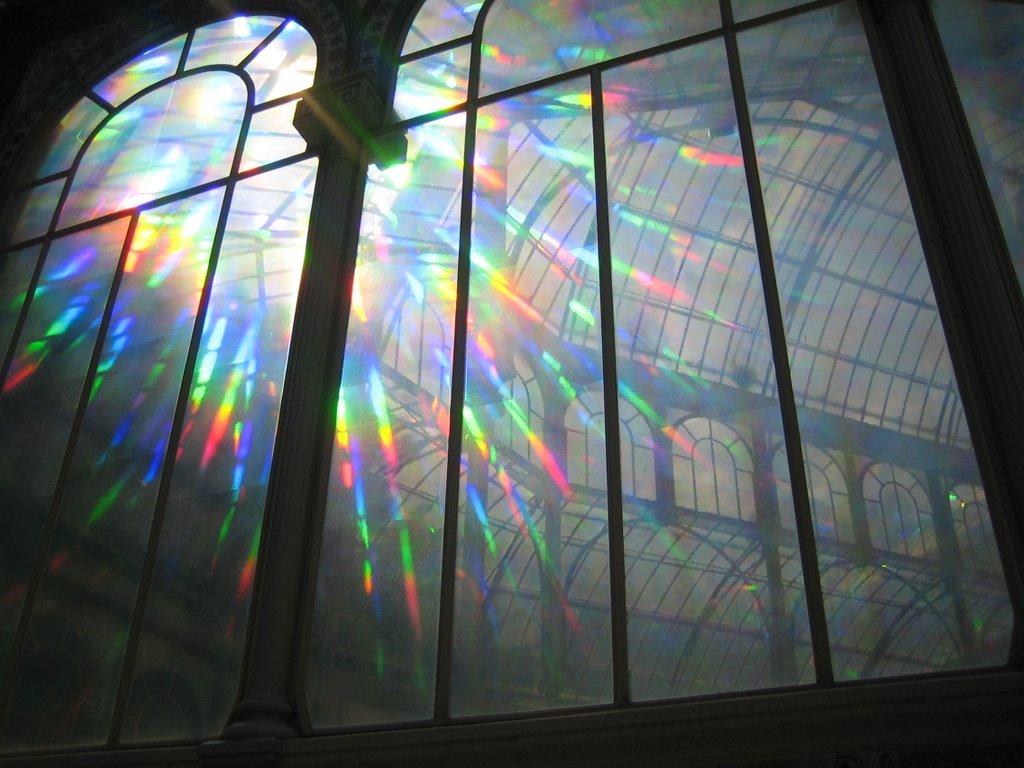
The top photo is of the Palacio de Cristal (Glass Palace), an exposition space in Retiro, Madrid's most civilized city park. I never get tired of going to see the Palacio because I love how I can see the leaves of the trees through the palace or the different ways the light plays on the panes of glass. Last June, I was in the park with some friends and we stopped by the Palacio to enter the free exhibition called "Breathe--A Woman Mirror" by the Korean artist Kimsooja. The floor of the Palacio was covered in mirrors and all the windows were covered by a translucent film that turned them into a prism. Unfortunately, I wasn't allowed to shoot photos inside. We had to take off our footwear and they provided socks so we could wander around atop the mirrors. It was quite the reflective exhibit.

Actually, Retiro was bustling that June weekend. It was the Feria del Libro de Madrid (the Madrid Book Fair), which had hundreds of stalls of Madrid publishing houses and bookstores, author talks, etc. Great fun to wander through--it's two weeks at the end of May/beginning of June every year. It also contained the notable globalizing presence of a Ben and Jerry's stand, which hit the spot.

The other Retiro happening was Yann Arthus-Bertrand's La Tierra Vista Desde Cielo (Earth from Above)-- an outdoor exhibition of enormous photos from around the world, all of which are accompanied by an informative caption. Many photos are taken to illustrate environmental problems or interesting geographic or man-made features. The photos are stunning. Hundreds quotations of statistics about the horrible impact of 21st-century humans on Earth are also part of the exhibit. Many have to do with the United States (i.e. Americans consume 478 times the amount of gasoline as developing nations ... statements in that vein).

Retiro is a wonderful place--both a retreat from Madrid's congested streets and a cultural center. But I feel a little more affinity with the Parque del Oeste, which lines the upper western side of the city center. It's closer to where I live; I run its hills and trails. When I first moved here, I considered Retiro Madrid's Central Park--though it's much much smaller than the New York version--and Parque del Oeste a little more Riverside Park-like (without the river*). It's less civilized in a way, less manicured than Retiro. Parque del Oeste slopes downhill from Moncloa (a huge transport hub) and never sees the kind of human traffic Retiro does, so it somehow feels a bit more personal.

[*A note about rivers: Madrid's biggest defect--in my view--is its lack of any serious body of water. We have a river, it's called the Manzanares, and most people have probably never seen it because it's either so low or the construction workers are busy moving it around in an attempt to enlarge the M-30--Madrid's Beltway. But, the Manzanares has its encanto. It starts way up in the sierra north of Madrid and I've bathed twice in its frigid pools and falls. You'd just never know that from looking at the pathetic thing snaking along the western edge of the city.]

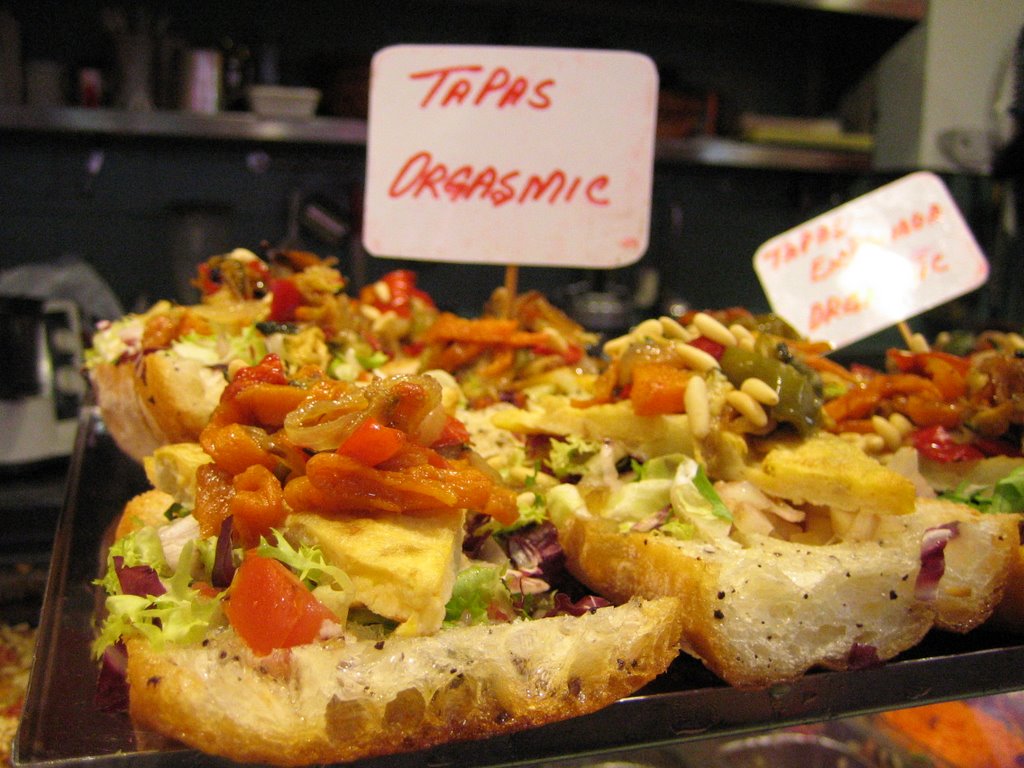
The second photo you see is from my favorite place in Barcelona--el Mercat de la Boqueria. Spain is full of markets, but this is the loveliest I've seen. The stands are mostly standard market products: fruit, vegetables, nuts and dried fruit, seafood, meat, bread and pastries, candy, etc. But the sellers seem to take a pride in their products that I've rarely seen: beautiful and careful arrangements of numerous varieties of fruits and veggies, nicely displayed meats and huge hanging hams, fresh seafood on beds of ice. And then you've got bars where you can get a bite to eat and a glass of tinto and, my personal favorite, the Organic is Orgasmic stand. It's run by a woman named Antonia who, apparently, loves delicious, organic food and serves it up at the market and at a nearby restaurant (that I haven't had time to patronize). They've got a very tempting salad bar at the market and the delicious tapas that you see on the left. I eat at least once at their stand when I've been to Barcelona.

Speaking of Barcelona, it's a really vibrant, interesting place that I enjoy immensely. It has a huge rivalry with Madrid. People are always comparing the two cities. I've spent about a week total on separate trips to Barcelona, and I've lived in Madrid for 13 months, so I can't really compare, but I have observations about differences in BCN. For one, it's got a much bigger alternative vibe than Madrid--tons of skaters, tons of dreads, piercings, tattoos, food like the stand I just wrote about. It's a little punkier, a little dirtier, a little earthier. Don't get me wrong: it's also got plenty of class and swank and businesspeople and the like. But I would estimate that Madrid has more. (I haven't even mentioned the football rivalry ... the two teams face off tonight for the first time this season.)

The last photo in the sidebar is taken at the spectacular Praia As Catedrais (Cathedrals Beach) beach on the northern coast of Galicia (Galicia is the northwest region of Spain). I traveled with my parents through the north of Spain last month and every Spaniard who heard we were going to Galicia told us this beach was a must-see. Well, it is. Rock pillars rise out of the blue sea, huge as towers. Waves crash against the rocks, and it's all very dramatic. We'd been following the coast since Llanes (in Asturias, just east of Galicia), and it was the most beautiful beach we saw (though there are plenty of gorgeous spots along the way). The Galician government has just declared it a natural monument, which I suppose will help protect it.

Before last month, I hadn't been to the north of Spain. On the trip, we spent most of our time in Asturias and Galicia, and both places are beautiful--and as different from central and southern Spain as you can imagine. Green green green. And rainy. Between driving crazy curvy roads, hiking through a breathtaking gorge in the Picos de Europa (left), beach crawling, wandering through old city centers, and eating, we had more than our fill of activities for the eight-day road trip. But there's a lot more exploring to be done up north...