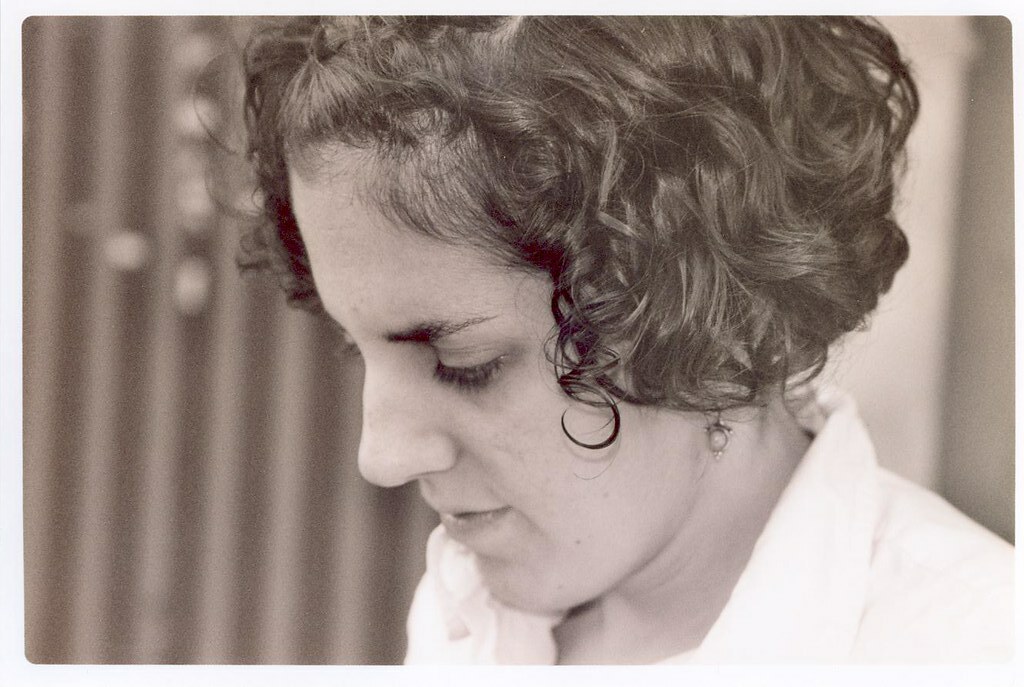
One of my very favorite neighborhoods in all of Madrid is what I call Conde Duque, the area between Calle Princesa and Malasaña (map). Just recently I also discovered that it is also home to the best croquetas I've ever had. La Tabernilla de Amadeus (C/ Cristo, 2--marked on the above map) sits on a tiny little street right near the Centro Cultural Conde Duque and has a lovely terraza during the summer. And the croquetas de jamón are, simply put, amazing.
Showing posts with label Madrid. Show all posts
Showing posts with label Madrid. Show all posts
Sunday, June 03, 2007
The best croquetas I've ever had
One of my very favorite neighborhoods in all of Madrid is what I call Conde Duque, the area between Calle Princesa and Malasaña (map). Just recently I also discovered that it is also home to the best croquetas I've ever had. La Tabernilla de Amadeus (C/ Cristo, 2--marked on the above map) sits on a tiny little street right near the Centro Cultural Conde Duque and has a lovely terraza during the summer. And the croquetas de jamón are, simply put, amazing.
Mi parque
 When I was looking for a place to live in Madrid nearly two years ago, I based it largely on living near a park where I could go running. I ended up near the Parque del Oeste (map), which I have completely fallen in love with. I call it mi parque and I really do feel a sense of propriety about it. I know the early morning dog walkers, the older couple who hit a tennis ball back and forth on one of the trails, the parks maintenance workers in their fluorescent yellow and blue outfits.
Parque del Oe
 ste slopes downhill from Moncloa and runs along the western edge of the city. It's great for running because of the dirt paths, the hills, and the lack of cars. It's also a perfect place to go for a stroll, lie in the grass, read on a bench, have a picnic, or box (?! left).
Parque del Oeste is quite different from the famed and (also) beautiful Parque del Buen Retiro. To begin with, it's not in the center of the city and therefore attracts much less traffic. I like to think of it as a little "wilder" than Retiro, in part because it's a little more off the beaten path. Though it's still quite a civilized place; so civilized, in fact, that it is home to a rosaleda (rose garden), which this year was absolutely fantastic. Seems that the cool, rainy spring we've had here has done wonders for the roses, which (when I went to see them two weeks ago) were in full bloom and stunning.
 To check out the Parque del Oeste, I recommend starting at one of its ends: (the Moncloa metro/bus station or the Templo de Debod) and wandering.
Monday, May 21, 2007
Peñalara
 As any Madrileño who loves the outdoors knows, we've got the mountains right in our backyard. Literally. In an hour by car, bus, or train, you can access some truly beautiful wild areas with fantastic hiking. I am a huge fan of La Pedriza, a natural area full of mounds of granite perfect for climbing and hiking. But a couple months ago, an adult student of mine piqued my interest when he recounted having spent part of his weekend attempting to climb Peñalara, the highest peak (2,430 meters) in the Sierra de Guardarrama, the mountain range closest to Madrid. This weekend, mi chico and I made our own attempt and succeeded.
You begin the ascent to Peñalara from the Puerto de Cotos, a mountain pass at 1,830 meters. It's only an hour in car from the center of Madrid, and can also be reached by train. We didn't have the highest hopes for our day--the INM predicted a 90% chance of rain and the sky was gray and threatening above as we began our uphill trek. Above the treeline, the wind began to whip against us with such a fury that I was afraid we'd be blown off the slope. But it didn't rain. In fact, we noticed as we got higher, the wind was blowing the ugly rain clouds away from us and onto the plains of Castilla-León. So we reached the summit quickly (it's a 600 meter ascent in a only a few kilometers) and continued on our loop down the other side of the summit and up a rocky pinnacle called Risco de los Claveles and down, down, down until we reached the first of several glacial lakes that would mark our return route.
 Soon enough we were walking through a meadow filled with wildflowers and flowing streams. Waterfalls cascaded from the rock walls below Peñalara, and the sun came out in a hole in clouds above us. We ate lunch by the lovely Laguna Grande before heading down the easy trail back to the car.
The circuit hike took us about four hours not including stops. Be forewarned that it's extremely popular (like most of the Guardarrama). We had a lot of company on a day with relatively bad weather. That student of mine hadn't made it to the top because of worse weather. A steward at the Laguna Grande told us that two years ago there were seven deaths on the peak due to winter unpreparedness. Best times to go are May, June, and September.


Sunday, May 20, 2007
San Isidro
 I love May in Madrid. Terrazas take over the sidewalks and plazas of our fair city, the grass and trees are green, the parks are full of flowers, days are long, and it's not too hot yet. And then there's San Isidro. He was a saint, a farmer (labrador), and a very good excuse for a party. That's right: he's Madrid's patron saint, which means that on the day that he died (May 15, 1130) everyone gets a holiday in Madrid!
The festivities started a bit earlier for me and some lucky friends. A colleague of mine is from a tiny town in the province of Cuenca, and there they also happen to have good old Isidro as their patron saint (for reasons unclear, maybe for the agricultural nature of the pueblo?). I've been lucky enough to spend two years attending the fiestas in Villaverde y Pasaconsol, which consist largely of dancing all night and eating all day.
 The most em
 blematic part of the fiestas in the pueblo is the toros. But they aren't full-grown toros, just vaquillas (little cows). All Saturday afternoon people enter the miniscule ring (composed of a whole bunch of truck beds) and run around with the vaquillas, trying not to get gored. The part I don't really like is that then they kill a couple--I didn't stay to watch that part. But the following morning, a bunch of people get up early and spend the whole morning guisando (cooking) the meat in gigantic pots. And then the whole town has a huge picnic with the meat and whatever people have brought: tortilla and plenty of bread, wine,
  and fruit.
Back in Madrid the party really got started on the Monday night before the holiday. The bars and streets of La Latina were completely packed, people were dancing chotis in the street at 1 a.m., and there was plenty of general merriment.
And on Sa
 n Isidro, hordes of people head to las praderas--the meadows--at a park named after the saint that lies in the southwestern part of the city (metro Marqués de Vadillo). I spent all afternoon there with my roommates and friends, eating pasta salad and watermelon and enjoying the good weather. Children and adults dress up as chulapas (with their long dresses and shawls) and chulapos (with their black-and-white checked caps) and, for a day, Madrid celebrates itself.
Sunday, May 06, 2007
Mother's Day
Today is Día de la Madre in Spain, in honor of which a couple of friends and I ran in the Carrera de la Mujer, a race for only women that raises money for cancer. Think Race for the Cure, Spanish style. The race shirts were orange, and the line to get water at the end was outrageously long. But even if it was less a race than a human obstacle course, tons of women came out for it. More than 12,000, in fact. It made me so happy to see so many Spanish women out exercising on a beautiful Sunday morning, that I'll ignore the fact that I had to wait half an hour to get water after I finished. To top it all off, the race bag came with an awesome amount of stuff (including another t-shirt, a towel, a Comunidad de Madrid Buff, and magazines ranging from Cosmo to Runner's World).
Election shenanigans
Election season is upon us here in España. I'm not incredibly informed, but I like to keep abreast of important developments, like the one I wrote about the other day. And we've got a new one today.
Good old Rafael Simancas, the socialist candidate for the presidency of the Madrid region, has a bone to pick with someone. In what appears to be an honest mistake, the metro station that shares his last name (a stop on line 7) has disappeared from the latest edition of the metro map. Granted, they've been opening what seems like 11 new stations every day for the past weeks. But Simancas is still open. At least that's what the neighbors say.
This weekend, the current president of the Comunidad, the right-wing Esperanza Aguirre, inaugurated the extension of line 7 to the far eastern reaches of our fair city, only making the elimination of the poor Simancas station from the map a little more suspicious.
Simanca has promised not to change the name of line 4's Esperanza station when he's president. But, he says, he will name Madrid's best golf tournament after her.
Good old Rafael Simancas, the socialist candidate for the presidency of the Madrid region, has a bone to pick with someone. In what appears to be an honest mistake, the metro station that shares his last name (a stop on line 7) has disappeared from the latest edition of the metro map. Granted, they've been opening what seems like 11 new stations every day for the past weeks. But Simancas is still open. At least that's what the neighbors say.
This weekend, the current president of the Comunidad, the right-wing Esperanza Aguirre, inaugurated the extension of line 7 to the far eastern reaches of our fair city, only making the elimination of the poor Simancas station from the map a little more suspicious.
Simanca has promised not to change the name of line 4's Esperanza station when he's president. But, he says, he will name Madrid's best golf tournament after her.
Thursday, April 26, 2007
"English for all"
 I found the above clipping in yesterday's El País. Elections in Madrid (for mayor and president of the Comunidad) are in just over a month, on May 27. I was most interested in a promise made by Rafael Simancas, the socialist candidate for president of the Comunidad (region), that "100% of young madrileños will speak English" thanks to the implementation of the bilingual program in public and concertado (parochial schools that receive some funding from the state) schools until the year 2015. In order to achieve this promise, Simancas proposes investing 320 million euros during the next two legislatures. As an auxiliar de conversación in a public school, I'm part of that goal already (and some of that money goes to people like me!).
Sunday, February 25, 2007
Sunday
I dreamt vividly of winter last night. Real snowy, cold winter.

The day dawned gray here in Madrid, with the same 40-50 degree F weather we've had all month. I had arranged to meet a friend in La Latina for the post-Rastro bar-hopping scene. Right before I left the house, it started pouring. By the time I surfaced at the La Latina metro station, the sun was shining hot--perfect for meandering among the crowds along the Cava Baja, to Calle Almendro, stopping in a few bars for cañas along the way. And at the end of Almendro, we found ourselves in the Plaza de San Andrés. Beginning to warm up to its springtime role, it was full of 20 and 30-somethings, sitting and soaking up the sun (when it didn't disappear behind the clouds), drinking liter bottles of Mahou, smoking... We grabbed a bocadillo from a nearby bar and joined them.

The day dawned gray here in Madrid, with the same 40-50 degree F weather we've had all month. I had arranged to meet a friend in La Latina for the post-Rastro bar-hopping scene. Right before I left the house, it started pouring. By the time I surfaced at the La Latina metro station, the sun was shining hot--perfect for meandering among the crowds along the Cava Baja, to Calle Almendro, stopping in a few bars for cañas along the way. And at the end of Almendro, we found ourselves in the Plaza de San Andrés. Beginning to warm up to its springtime role, it was full of 20 and 30-somethings, sitting and soaking up the sun (when it didn't disappear behind the clouds), drinking liter bottles of Mahou, smoking...
 We grabbed a bocadillo from a nearby bar and joined them.
Saturday, January 20, 2007
The return
I was struck by the dull dark grayness of the Madrid sky when we emerged from the metro midday on January 8. It was a gray unlike anything I'd seen before: oppressive, thick. All the cars and buildings looked like they'd been covered in a layer of dust, dirt, and soot. The air reeked of a mixture of diesel fumes and cigarette smoke that seemed to hang in the intersections where pedestrians waited for the light to change and tried to keep warm.
Maybe it was that I was exhausted from the overnight flight and attempting to sleep in the few hours between dinner and the inedible breakfast. Maybe it was that I was coming from the smoke-free paradise known as the United States. Maybe it's that Madrid needs a good rain to clean the soot off the façades of the buildings and the dog crap from the sidewalks.
Maybe it was that I was exhausted from the overnight flight and attempting to sleep in the few hours between dinner and the inedible breakfast. Maybe it was that I was coming from the smoke-free paradise known as the United States. Maybe it's that Madrid needs a good rain to clean the soot off the façades of the buildings and the dog crap from the sidewalks.
Wednesday, December 13, 2006
La cesta


Christmas has hit Madrid in a big way. Lights are everywhere (Madrid apparently has spent several times the money on lights as any other Spanish city), the belén (nativity) has been constructed in the entrance of my school, stores are open on Sundays, Papa Noel climbs store fronts and dangles from apartment windows. (The other day I witnessed a three-year old boy yelling up to a stuffed Santa perched above a store awning. He was telling him what he wanted for Christmas. His mother looked on patiently.)
Even in workplaces the joys are many. Yesterday I lugged home my cesta de navidad ("Christmas basket") from the security company where I teach classes three hours a week. For my three hours, I get the same cesta as the full-time employees. Not a bad deal.
It was so heavy, however, that I almost expired carrying it through the metro and the four blocks to my apartment. Thankfully one of my students gave me a ride to a metro station just a couple stops (and the same line) from where I live (normally it's a 45-minute trip with a long walk between two different lines). But Oh. My. God. Said basket contains six bottles of various libations: 3 wines (two red, one white), 2 bottles of cava (Catalán champagne), and one of whiskey. Then you've got four tablets of turrón--a typical Spanish Christmas sweet made out of almonds--, cookies, chocolate covered almonds, and cans of olives, hearts of palm, pineapple, and peaches.
The cesta is tradition here in almost every company. My roommate got one too: with a jamón (that is, a cured pig's leg) and cheese, among other things. My students at the security company, though, were complaining about the one we received. One of them said, "Well, the wine is drinkable."
I don't care. I'm thrilled.
Monday, December 04, 2006
An organic buffet and some carrot cake
The other day a friend and I were searching for a place to eat. (In Spanish the way you talk about the midday meal (la comida--"the meal") is not "to have lunch," but rather just "to eat" (comer)). So if I say we were looking for a place to eat, in my Spanish-ized way of thinking I mean we were looking for a place to eat lunch.
Well, it was a little late for lunch (though Spanish lunches are relatively late there's a short window: 2-4 p.m.), so we'd already gotten turned down at one place. But lo and behold, across from the failed attempt on Calle Huertas, we discovered a fabulous organic market and buffet where we salivated and debated over how best to ration the chickpeas, seitan, and veggie lasagna to keep our plates down to a reasonable price (it was 1.80 euros per 100 grams). The food was delicious--flavorful and filling without being meat or fried--and a welcome change from typical Spanish restaurant fare. One of the best things about the place was that there was also a tiny dessert buffet with some yummy-looking carrot cake--not exactly the most popular dessert in España. We shared a piece and were completely inspired to make our own.

So we spent Sunday afternoon grating carrots, chopping walnuts, beating the cream cheese icing by hand, and trying to fit two layers of cake into my tiny oven. At the end of it all we had assembled a beautiful (and really tasty) carrot cake. The recipe is from the Frog Commissary and loved by my mother. We found it online and modified it slightly.
Well, it was a little late for lunch (though Spanish lunches are relatively late there's a short window: 2-4 p.m.), so we'd
 already gotten turned down at one place. But lo and behold, across from the failed attempt on Calle Huertas, we discovered a fabulous organic market and buffet where we salivated and debated over how best to ration the chickpeas, seitan, and veggie lasagna to keep our plates down to a reasonable price (it was 1.80 euros per 100 grams). The food was delicious--flavorful and filling without being meat or fried--and a welcome change from typical Spanish restaurant fare. One of the best things about the place was that there was also a tiny dessert buffet with some yummy-looking carrot cake--not exactly the most popular dessert in España. We shared a piece and were completely inspired to make our own.
So we spent Sunday afternoon grating carrots, chopping walnuts, beating the cream cheese icing by hand, and trying to fit two layers of cake into my tiny oven. At the end of it all we had assembled a beautiful (and really tasty) carrot cake. The recipe is from the Frog Commissary and loved by my mother. We found it online and modified it slightly.
Wednesday, November 29, 2006
Two, of many, great things about Madrid
1. El Tigre is a bar in the center of Madrid (C/ Infantas), just off of Gran Vía, an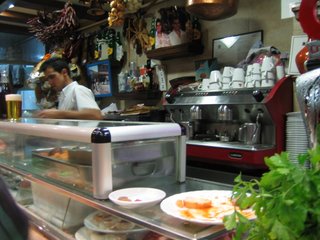 d in the über-trendy and gay barrio, Chueca. But this bar is neither trendy nor gay. It's always bustling -- and with good reason. With a 1.50 euro caña (small beer) you get a plate full of whatever's on the grill and more: patatas bravas, croquetas, jamón, egg, fried peppers, cheese. The guys behind the bar yell orders constantly, while pouring beers, and move as if bartending were a choreographed art. You have to fight your way to the bar and perch your plate wherever you can, but a tasty and filling meal for under 5 euros (that's three cañas) and great ambiente are worth it.
2. Casa Granada is a rooftop terrace restaurant hidden atop an ordinary and totally unassuming apartment building.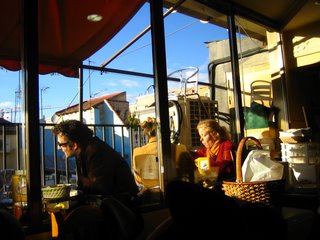 You have to be in the know to find the place, just north of metro Tirso de Molina, and once you've buzzed up, ride in the elevator plastered with signs begging riders to adhere to the four-person limit. It's within spitting distance of the Rastro, La Latina's gigantic Sunday flea market, which makes it the perfect place for a meal after navigating the crowds and t-shirt stands. You might have to wait a while for a table, but you'll be glad you did. What else is there to do on Sunday but eat and drink? And meanwhile, you can order a beer and wander out to the terrace for amazingly grand views of Madrid and her suburbs. The raciones are delicious and inexpensive. For two, a plate of pimientos de padrón (tiny peppers fried in oil and sprinkled with sea salt) and one of calamares were more than enough, and cost 11 euros.
 d in the über-trendy and gay barrio, Chueca. But this bar is neither trendy nor gay. It's always bustling -- and with good reason. With a 1.50 euro caña (small beer) you get a plate full of whatever's on the grill and more: patatas bravas, croquetas, jamón, egg, fried peppers, cheese. The guys behind the bar yell orders constantly, while pouring beers, and move as if bartending were a choreographed art. You have to fight your way to the bar and perch your plate wherever you can, but a tasty and filling meal for under 5 euros (that's three cañas) and great ambiente are worth it.
2. Casa Granada is a rooftop terrace restaurant hidden atop an ordinary and totally unassuming apartment building.
 You have to be in the know to find the place, just north of metro Tirso de Molina, and once you've buzzed up, ride in the elevator plastered with signs begging riders to adhere to the four-person limit. It's within spitting distance of the Rastro, La Latina's gigantic Sunday flea market, which makes it the perfect place for a meal after navigating the crowds and t-shirt stands. You might have to wait a while for a table, but you'll be glad you did. What else is there to do on Sunday but eat and drink? And meanwhile, you can order a beer and wander out to the terrace for amazingly grand views of Madrid and her suburbs. The raciones are delicious and inexpensive. For two, a plate of pimientos de padrón (tiny peppers fried in oil and sprinkled with sea salt) and one of calamares were more than enough, and cost 11 euros.
Sunday, November 05, 2006
La calle es de todos
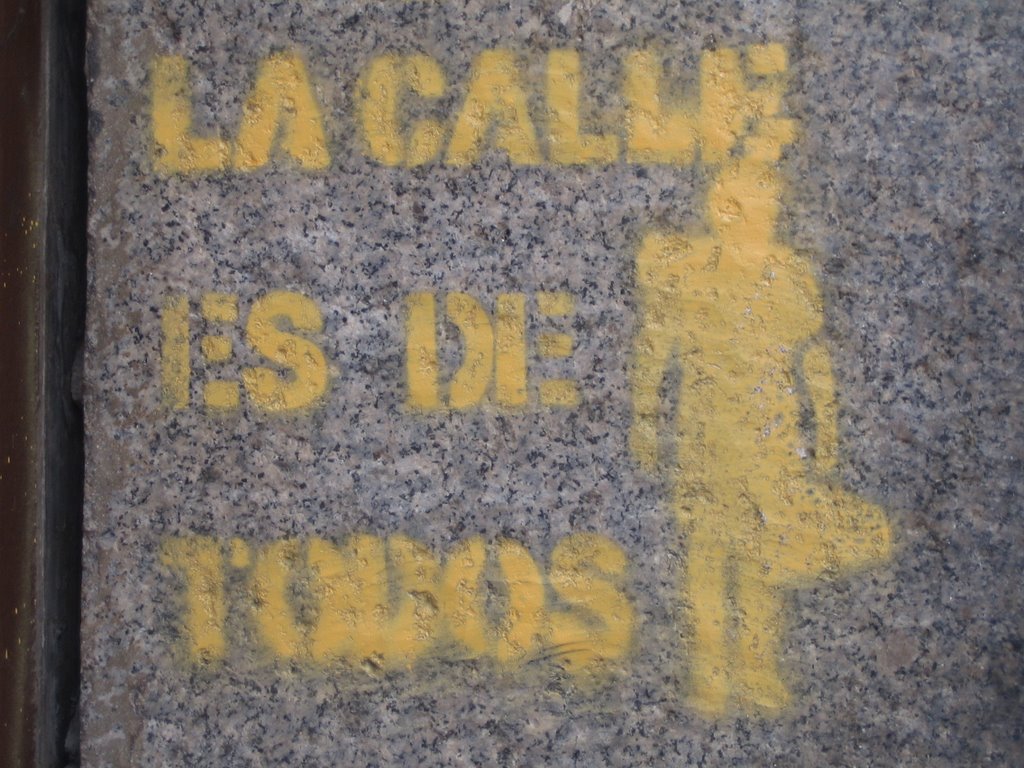 The street is for everyone. I saw these words stenciled on a building in the center of Madrid while wandering around with a friend last week. It seems an appropriate thing to say about Madrid, where so much life is concentrated on the streets. I'm not just talking about the homeless people here, who sleep on benches, building entrances, and in parks, or the crippled beggars who sit in the middle of the sidewalk on Gran Via and ask for change. Or even the groups of teenagers who congregate in the alleyway under my window late at night. I'm talking about all Madrileños, old and young, Spanish and foreign, pijo and alternativo. I'm talking about the West Africans selling pirated DVDs on the streets and in the Metro entrances, the gay couple embracing outside the Palacio Real, the Pakistani man smoking a cigarette outside his non-smoking locutorio, the Ecuadorans picnicking in Parque del Oeste every Sunday, the Peruvian musicians playing in Sol.
I'm talking about Lavapiés, probably the most ethnically diverse neighborhood in the center of Madrid. I was there three times in the last week--one night for a kebab, one night for Indian food, and today as we looked for a less crowded alternative to La Latina to eat outside on this cloudy,
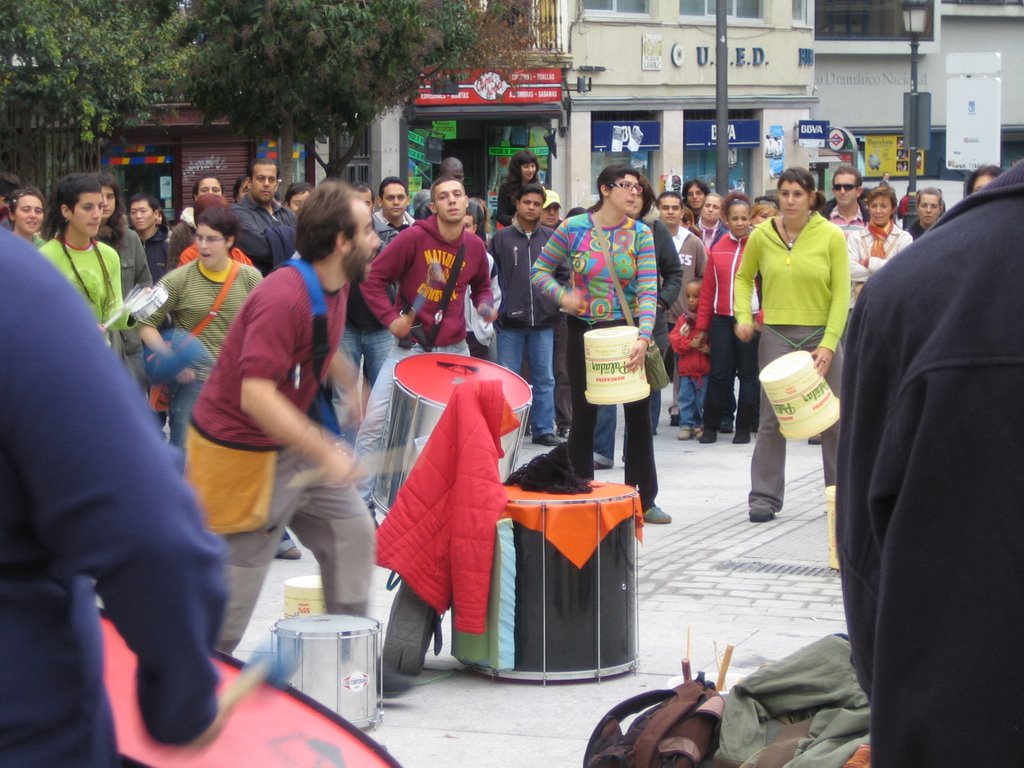 chilly, but not rainy day. It was just our luck to come across a terraza with an empty table just north of an enormous drum circle congregated in the plaza. Now, Lavapiés has become semi-trendy among Madrileños who dig the ethnic food and the alternative Spanish tabernas, the art and music scene, and the wonderful old architecture. But whenever I go there I can't forget what one of my female Spanish friends told me once: that she had been really interested in taking a flamenco class at El Horno, a dance center in the neighborhood, but had ultimately decided against it based on the fact that the class would end around 7 p.m. and the streets would be full of immigrants just standing around and looking at her. I couldn't help thinking that it was a terrible shame to give up the class for that reason. La calle es de todos, ¿no?
Washing
 These municipal workers are busy washing the street right outside my apartment. This was during a sunny interlude between two rainy weeks in Madrid. What is most amazing to me is that they wash the streets even on the rainy days. But they're worried about the lack of water in Spain?
Sunday, October 29, 2006
Easy like Sunday morning
The deluge is over. Madrid is back to its normal sunny self, at least for the time being. The weekend has been gorgeous and the Madrileños are out in full force, doing what they love best: getting dressed and having a drink at one of the hundreds of terrazas in the city. Families with hordes of children dressed in the cutest Spanish kids' clothes, couples young and old, singles with a dog or a book or a paper. They're having a beer or a clara or a café con leche, accompanied by the ubquitous plate of patatas fritas. It's Sunday--what else is there to do?
On Sundays, Spain virtually shuts down. Generally the only businesses open are bars and restaurants, bakeries, and pharmacies. You can find convenience stores open in the big cities. So, what to do? Eat and drink, of course. Sit in a bar or a terraza, people watching, being social. Pasear with your new baby in his 800-euro stroller, stopping every hundred meters or so when someone wants to ogle your adorable addition to the world. Play tennis, go running, clean the house, do laundry. More or less typical weekend things, with a Spanish flair.
I spent Sunday morning running a race--the second annual Retiro District 10K. I did it last year, too, but under notably different circumstances. I'd been unable to sign-up because they'd capped it at 2,000 runners. But out in a bar the night before the race a friend suggested that what the hell? We'd run it anyway, just without numbers. And we did, after sleeping about four hours. Well, this year I made sure to sign up early and go to bed at a reasonable hour. No biggie that I signed up, though. I arrived to pick up my timing chip on race day, and they apologetically informed us that the chips for race numbers 1300 and up had been stolen. Huh? Yes, it's true. So we ran without chips and lined up after finishing to report our times to a woman with pen and paper. No problem.
My main problem with races here is post-race. Maybe I got spoiled running all those New York Road Runner races in Central Park, which run like clockwork and dependably feature huge tables of water and some sort of food just after crossing the finish line. Lamentably, at none of the four races I've run here has food played a role for we poor hungry runners. But on several occasions you could cross the finish and drink a Coke right away! You had to wait in a long line for your goodie bag with one puny bottle of water. When I cross the finish, I want to gulp down several cups of water in quick sucession. I don't want a Coke, or a Nestea, or whatever sugary drink is sponsoring the race. And I definitely don't want to wait fifteen minutes in line to get the tiny bit of water that's in my race bag. Why does Coca-Cola sponsor the races I've run in Madrid? Where are the bananas, apples, and bagels for chrissake!?
On Sundays, Spain virtually shuts down. Generally the only businesses open are bars and restaurants, bakeries, and pharmacies. You can find convenience stores open in the big cities. So, what to do? Eat and drink, of course. Sit in a bar or a terraza, people watching, being social. Pasear with your new baby in his 800-euro stroller, stopping every hundred meters or so when someone wants to ogle your adorable addition to the world. Play tennis, go running, clean the house, do laundry. More or less typical weekend things, with a Spanish flair.
I spent Sunday morning running a race--the second annual Retiro District 10K. I did it last year, too, but under notably different circumstances. I'd been unable to sign-up because they'd capped it at 2,000 runners. But out in a bar the night before the race a friend suggested that what the hell? We'd run it anyway, just without numbers. And we did, after sleeping about four hours. Well, this year I made sure to sign up early and go to bed at a reasonable hour. No biggie that I signed up, though. I arrived to pick up my timing chip on race day, and they apologetically informed us that the chips for race numbers 1300 and up had been stolen. Huh? Yes, it's true. So we ran without chips and lined up after finishing to report our times to a woman with pen and paper. No problem.
My main problem with races here is post-race. Maybe I got spoiled running all those New York Road Runner races in Central Park, which run like clockwork and dependably feature huge tables of water and some sort of food just after crossing the finish line. Lamentably, at none of the four races I've run here has food played a role for we poor hungry runners. But on several occasions you could cross the finish and drink a Coke right away! You had to wait in a long line for your goodie bag with one puny bottle of water. When I cross the finish, I want to gulp down several cups of water in quick sucession. I don't want a Coke, or a Nestea, or whatever sugary drink is sponsoring the race. And I definitely don't want to wait fifteen minutes in line to get the tiny bit of water that's in my race bag. Why does Coca-Cola sponsor the races I've run in Madrid? Where are the bananas, apples, and bagels for chrissake!?
Thursday, October 26, 2006
Concrete schoolyard
Recess is a whirling chaos. On the "patio," the concrete schoolyard ubiquitous in Madrid, children are throwing themselves at each other, down the slide in the tiny playset, or on the ground, as is the case with the majority of the three-year olds who waddle around like tiny penguins with snotty noses and pint-size clothing. Dramas are acted out daily on the school playground, complete with accusations, tears, and denials.
I never went to school in the center of a city (well, until college in New York), so I spent elementary school on expansive playgrounds with fields, lots of play equipment, and serious amounts of space to chase boys.
Here in Madrid, everything is confined to a smaller space, and tensions run high on the concrete schoolyard. The seven-year old second graders are the big kids, towering over the likes of the pre-school children, concerned with scoring a goal at all cost and hardly noticing if they knock over one of the waddlers or send a ball flying at the head of one the teachers who has recess duty. The first graders were five-year olds last year, and still waver between pre-school immaturity and joining the big kids' game. So they dangle from the tiny, overcrowded playset, waiting for the right moment to go for the ball.
The three-year olds still don't know they actually go to school, and stare with mucus-filled faces at the more experienced kids whizzing around them. Or they fall over and entertain each other on the concrete. The four-year olds are too cool for the three-year olds. They know how this playground thing goes, and have the guts to run around with some of the bigger kids and tattle on those who commit offenses. The five-year olds play among themselves--confident in their position as oldest of the infantil classes. They only call the teachers' attention when one of them gets knocked over and all of her friends make sure that she's properly attended.
At 11:30 the bell rings and it's all over. Until tomorrow.
I never went to school in the center of a city (well, until college in New York), so I spent elementary school on expansive playgrounds with fields, lots of play equipment, and serious amounts of space to chase boys.
Here in Madrid, everything is confined to a smaller space, and tensions run high on the concrete schoolyard. The seven-year old second graders are the big kids, towering over the likes of the pre-school children, concerned with scoring a goal at all cost and hardly noticing if they knock over one of the waddlers or send a ball flying at the head of one the teachers who has recess duty. The first graders were five-year olds last year, and still waver between pre-school immaturity and joining the big kids' game. So they dangle from the tiny, overcrowded playset, waiting for the right moment to go for the ball.
The three-year olds still don't know they actually go to school, and stare with mucus-filled faces at the more experienced kids whizzing around them. Or they fall over and entertain each other on the concrete. The four-year olds are too cool for the three-year olds. They know how this playground thing goes, and have the guts to run around with some of the bigger kids and tattle on those who commit offenses. The five-year olds play among themselves--confident in their position as oldest of the infantil classes. They only call the teachers' attention when one of them gets knocked over and all of her friends make sure that she's properly attended.
At 11:30 the bell rings and it's all over. Until tomorrow.
Monday, October 23, 2006
Vaya
Tonight I'm walking home from the metro after my conversation class with some guys at a security systems company, and I'm totally in another world ... listening to my music, checking out all the store windows that have been so cruelly enticing me in this month in which I am poor poor poor. And, boom! I've run into someone. I whip around, shocked out of my reverie, and remove one headphone just in time to hear "Eres tonta, eh!" (You are stupid!) out of the mouth of the older woman I bumped into. Hey, did you think I was planning to run into you? I may be distracted, but I'm not stupid.
Sunday, October 22, 2006
Photographic ramblings
I wanted to explain a little about the photos I've posted because they represent some of the things that I love about Spain.
The top photo is of the Palacio de Cristal (Glass Palace), an exposition space in Retiro, Madrid's most civilized city park. I never get tired of going to see the Palacio because I love how I can see the leaves of the trees through the palace or the different ways the light plays on th e panes of glass. Last June, I was in the park with some friends and we stopped by the Palacio to enter the free exhibition called "Breathe--A Woman Mirror" by the Korean artist Kimsooja. The floor of the Palacio was covered in mirrors and all the windows were covered by a translucent film that turned them into a prism. Unfortunately, I wasn't allowed to shoot photos inside. We had to take off our footwear and they provided socks so we could wander around atop the mirrors. It was quite the reflective exhibit.
Actually, Retiro was bustling that June weekend. It was the Feria del Libro de Madrid (the Madrid Book Fair), which had hundreds of stalls of Madrid publishing houses and bookstores, author talks, etc. Great fun to wander through--it's two weeks at the end of May/beginning of June every year. It also contained the notable globalizing presence of a Ben and Jerry's stand, which hit the spot.
The other Retiro happening was Yann Arthus-Bertrand's La Tierra Vista Desde Cielo (Earth from Above)-- an outdoor exhibition of enormous photos from around the world, all of which are accompanied by an informative caption. Many photos are taken to illustrate environmental problems or interesting geographic or man-made features. The photos are stunning. Hundreds quotations of statistics about the horrible impact of 21st-century humans on Earth are also part of the exhibit. Many have to do with the United States (i.e. Americans consume 478 times the amount of gasoline as developing nations ... statements in that vein).
Retiro is a wonderful place--both a retreat from Madrid's congested streets and a cultural center. But I feel a little more affinity with the Parque del Oeste, which lines the upper western side of the city center. It's closer to where I live; I run its hills and trails. When I first moved here, I considered Retiro Madrid's Central Park--though it's much much smaller than the New York version--and Parque del Oeste a little more Riverside Park-like (without the river*). It's less civilized in a way, less manicured than Retiro. Parque del Oeste slopes downhill from Moncloa (a huge transport hub) and never sees the kind of human traffic Retiro does, so it somehow feels a bit more personal.
[*A note about rivers: Madrid's biggest defect--in my view--is its lack of any serious body of water. We have a river, it's called the Manzanares, and most people have probably never seen it because it's either so low or the construction workers are busy moving it around in an attempt to enlarge the M-30--Madrid's Beltway. But, the Manzanares has its encanto. It starts way up in the sierra north of Madrid and I've bathed twice in its frigid pools and falls. You'd just never know that from looking at the pathetic thing snaking along the western edge of the city.]
The second photo you see is from my favorite place in Barcelona--el Mercat de la Boqueria. Spain is full of markets, but this is the loveliest I've seen. The stands are mostly standard market products: fruit, vegetables, nuts and dried fruit, seafood, meat, bread and pastries, candy, etc. But the sellers seem to take a pride in their products that I've rarely seen: beautiful and careful arrangements of numerous varieties of fruits and veggies, nicely displayed meats and huge hanging hams, fresh seafood on beds of ice. And then you've got bars where you can get a bite to eat and a glass of tinto and, my personal favorite, the Organic is Orgasmic stand. It's run by a woman named Antonia who, apparently, loves delicious, organic food and serves it up at the market and at a nearby restaurant (that I haven't had time to patronize). They've got a very tempting salad bar at the market and the delicious tapas that you see on the left. I eat at least once at their stand when I've been to Barcelona.
Speaking of Barcelona, it's a really vibrant, interesting place that I enjoy immensely. It has a huge rivalry with Madrid. People are always comparing the two cities. I've spent about a week total on separate trips to Barcelona, and I've lived in Madrid for 13 months, so I can't really compare, but I have observations about differences in BCN. For one, it's got a much bigger alternative vibe than Madrid--tons of skaters, tons of dreads, piercings, tattoos, food like the stand I just wrote about. It's a little punkier, a little dirtier, a little earthier. Don't get me wrong: it's also got plenty of class and swank and businesspeople and the like. But I would estimate that Madrid has more. (I haven't even mentioned the football rivalry ... the two teams face off tonight for the first time this season.)
The last photo in the sidebar is taken at the spectacular Praia As Catedrais (Cathedrals Beach) beach on the northern coast of Galicia (Galicia is the northwest region of Spain). I traveled with my parents through the north of Spain last month and every Spaniard who heard we were going to Galicia told us this beach was a must-see. Well, it is. Rock pillars rise out of the blue sea, huge as towers. Waves crash against the rocks, and it's all very dramatic. We'd been following the coast since Llanes (in Asturias, just east of Galicia), and it was the most beautiful beach we saw (tho ugh there are plenty of gorgeous spots along the way). The Galician government has just declared it a natural monument, which I suppose will help protect it.
Before last month, I hadn't been to the north of Spain. On the trip, we spent most of our time in Asturias and Galicia, and both places are beautiful--and as different from central and southern Spain as you can imagine. Green green green. And rainy. Between driving crazy curvy roads, hiking through a breathtaking gorge in the Picos de Europa (left), beach crawling, wandering through old city centers, and eating, we had more than our fill of activities for the eight-day road trip. But there's a lot more exploring to be done up north...
The top photo is of the Palacio de Cristal (Glass Palace), an exposition space in Retiro, Madrid's most civilized city park. I never get tired of going to see the Palacio because I love how I can see the leaves of the trees through the palace or the different ways the light plays on th
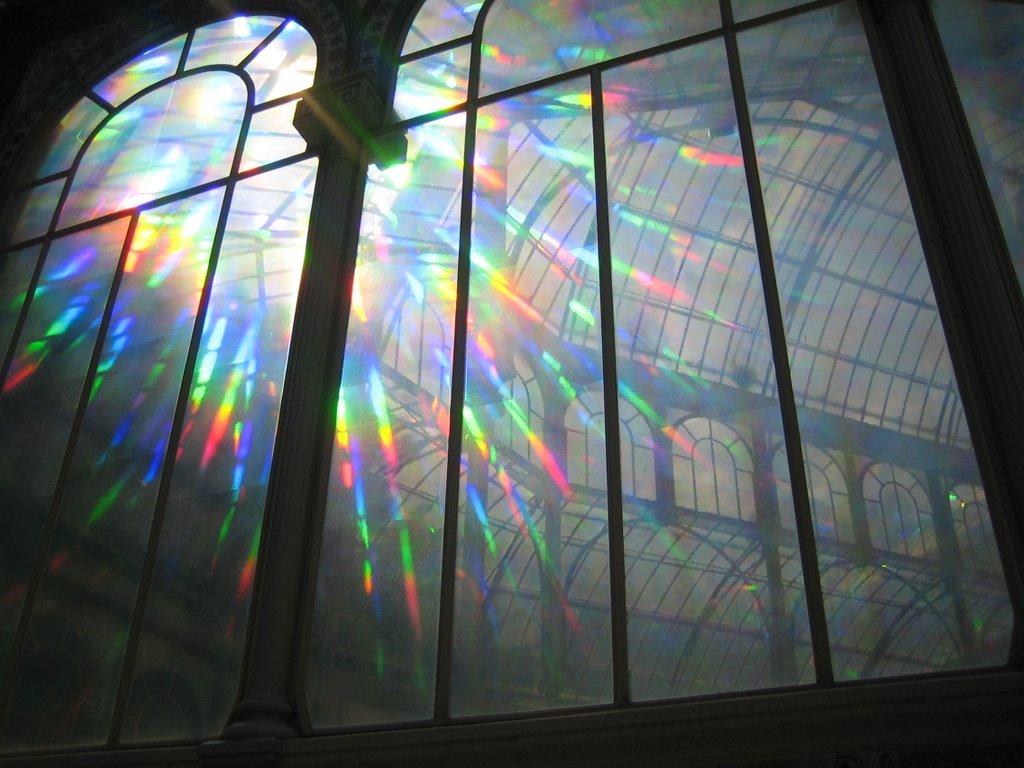 e panes of glass. Last June, I was in the park with some friends and we stopped by the Palacio to enter the free exhibition called "Breathe--A Woman Mirror" by the Korean artist Kimsooja. The floor of the Palacio was covered in mirrors and all the windows were covered by a translucent film that turned them into a prism. Unfortunately, I wasn't allowed to shoot photos inside. We had to take off our footwear and they provided socks so we could wander around atop the mirrors. It was quite the reflective exhibit.
Actually, Retiro was bustling that June weekend. It was the Feria del Libro de Madrid (the Madrid Book Fair), which had hundreds of stalls of Madrid publishing houses and bookstores, author talks, etc. Great fun to wander through--it's two weeks at the end of May/beginning of June every year. It also contained the notable globalizing presence of a Ben and Jerry's stand, which hit the spot.
The other Retiro happening was Yann Arthus-Bertrand's La Tierra Vista Desde Cielo (Earth from Above)-- an outdoor exhibition of enormous photos from around the world, all of which are accompanied by an informative caption. Many photos are taken to illustrate environmental problems or interesting geographic or man-made features. The photos are stunning. Hundreds quotations of statistics about the horrible impact of 21st-century humans on Earth are also part of the exhibit. Many have to do with the United States (i.e. Americans consume 478 times the amount of gasoline as developing nations ... statements in that vein).
Retiro is a wonderful place--both a retreat from Madrid's congested streets and a cultural center. But I feel a little more affinity with the Parque del Oeste, which lines the upper western side of the city center. It's closer to where I live; I run its hills and trails. When I first moved here, I considered Retiro Madrid's Central Park--though it's much much smaller than the New York version--and Parque del Oeste a little more Riverside Park-like (without the river*). It's less civilized in a way, less manicured than Retiro. Parque del Oeste slopes downhill from Moncloa (a huge transport hub) and never sees the kind of human traffic Retiro does, so it somehow feels a bit more personal.
[*A note about rivers: Madrid's biggest defect--in my view--is its lack of any serious body of water. We have a river, it's called the Manzanares, and most people have probably never seen it because it's either so low or the construction workers are busy moving it around in an attempt to enlarge the M-30--Madrid's Beltway. But, the Manzanares has its encanto. It starts way up in the sierra north of Madrid and I've bathed twice in its frigid pools and falls. You'd just never know that from looking at the pathetic thing snaking along the western edge of the city.]
The second photo you see is from my favorite place in Barcelona--el Mercat de la Boqueria. Spain is full of markets, but this is the loveliest I've seen. The stands are mostly standard market products: fruit, vegetables, nuts and dried fruit, seafood, meat, bread and pastries, candy, etc. But the sellers seem to take a pride in their products that I've rarely seen: beautiful and careful arrangements of numerous varieties of fruits and veggies, nicely displayed meats and huge hanging hams, fresh seafood on beds of ice. And then you've got bars where you can get a
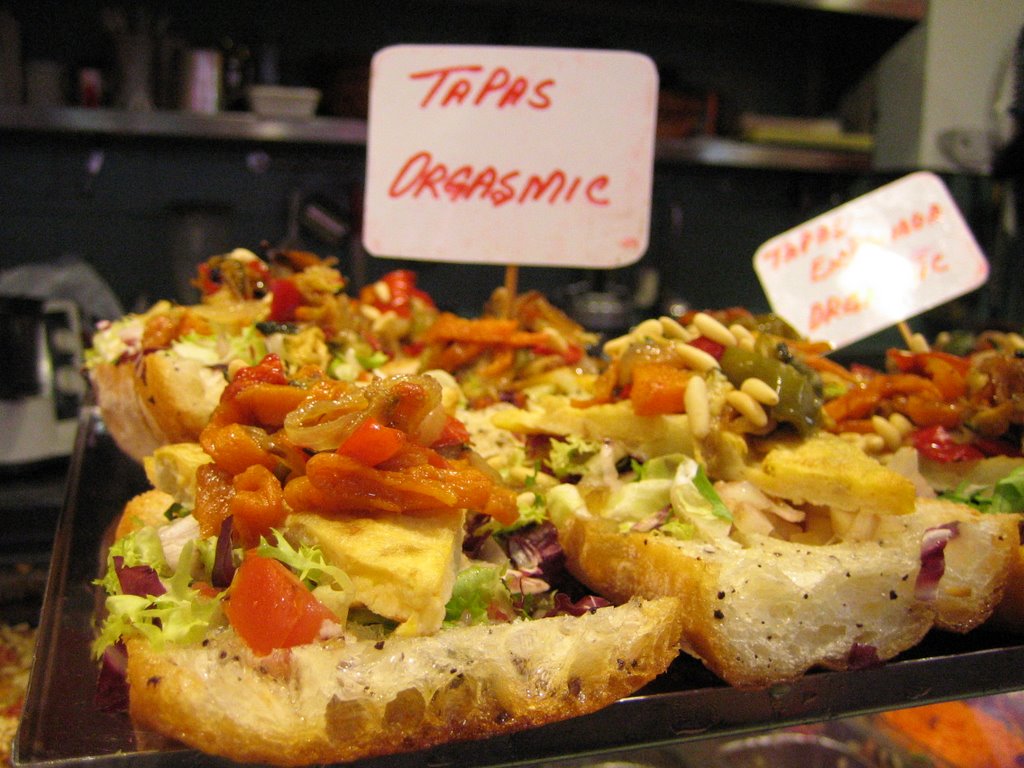 bite to eat and a glass of tinto and, my personal favorite, the Organic is Orgasmic stand. It's run by a woman named Antonia who, apparently, loves delicious, organic food and serves it up at the market and at a nearby restaurant (that I haven't had time to patronize). They've got a very tempting salad bar at the market and the delicious tapas that you see on the left. I eat at least once at their stand when I've been to Barcelona.
Speaking of Barcelona, it's a really vibrant, interesting place that I enjoy immensely. It has a huge rivalry with Madrid. People are always comparing the two cities. I've spent about a week total on separate trips to Barcelona, and I've lived in Madrid for 13 months, so I can't really compare, but I have observations about differences in BCN. For one, it's got a much bigger alternative vibe than Madrid--tons of skaters, tons of dreads, piercings, tattoos, food like the stand I just wrote about. It's a little punkier, a little dirtier, a little earthier. Don't get me wrong: it's also got plenty of class and swank and businesspeople and the like. But I would estimate that Madrid has more. (I haven't even mentioned the football rivalry ... the two teams face off tonight for the first time this season.)
The last photo in the sidebar is taken at the spectacular Praia As Catedrais (Cathedrals Beach) beach on the northern coast of Galicia (Galicia is the northwest region of Spain). I traveled with my parents through the north of Spain last month and every Spaniard who heard we were going to Galicia told us this beach was a must-see. Well, it is. Rock pillars rise out of the blue sea, huge as towers. Waves crash against the rocks, and it's all very dramatic. We'd been following the coast since Llanes (in Asturias, just east of Galicia), and it was the most beautiful beach we saw (tho
 ugh there are plenty of gorgeous spots along the way). The Galician government has just declared it a natural monument, which I suppose will help protect it.
Before last month, I hadn't been to the north of Spain. On the trip, we spent most of our time in Asturias and Galicia, and both places are beautiful--and as different from central and southern Spain as you can imagine. Green green green. And rainy. Between driving crazy curvy roads, hiking through a breathtaking gorge in the Picos de Europa (left), beach crawling, wandering through old city centers, and eating, we had more than our fill of activities for the eight-day road trip. But there's a lot more exploring to be done up north...
Friday, October 20, 2006
Intro
Spain and I have a love/hate relationship. It's been a year so far with plenty of ups and downs--but we're still together. I learn new things and discover new places every single day thanks to my intimate involvement with the bustling, polluted, cranky, and cosmopolitan capital. I walk its streets. I teach its kids. I ride its metro and buses. I run in its parks. I know its bakers, its bar owners, its dentists, its supermarket cashiers. We're still getting to know each other, though. We've got time.
I've been thinking and talking about blogging for a long time. Sort of like how I thought about yoga a lot over summer vacation, and recommended it to my friends. Without actually doing it. (My yoga teacher loved that one--hey, we could call it "katie-asana.") But the time has come--back to work, back to yoga classes, time to start blogging.
Right now we are experiencing a nearly unheard of phenomenon in Madrid. Rain. It's been raining since Tuesday. Thank goodness, though. We need it--Madrid is notoriously dry.
Yesterday, crossing a busy intersection in the rain, I reflected on the frequent use of vulgarity here in good old España. A man crossing ahead of me, nearly run over by a guy who was oblivious to the fact that we had the right of way, smacked the car's hood and yelled, "¿A dónde vas, coño?" That is, "Where are you going, cunt?" Only in Spain.
I've been thinking and talking about blogging for a long time. Sort of like how I thought about yoga a lot over summer vacation, and recommended it to my friends. Without actually doing it. (My yoga teacher loved that one--hey, we could call it "katie-asana.") But the time has come--back to work, back to yoga classes, time to start blogging.
Right now we are experiencing a nearly unheard of phenomenon in Madrid. Rain. It's been raining since Tuesday. Thank goodness, though. We need it--Madrid is notoriously dry.
Yesterday, crossing a busy intersection in the rain, I reflected on the frequent use of vulgarity here in good old España. A man crossing ahead of me, nearly run over by a guy who was oblivious to the fact that we had the right of way, smacked the car's hood and yelled, "¿A dónde vas, coño?" That is, "Where are you going, cunt?" Only in Spain.
Subscribe to:
Posts (Atom)